KING ROGER
By Karol Szymanowski
Libretto by Karol Szymanowski and Jarosław Iwaszkiewicz
Produced by Des Moines Metro Opera. Directed by Chas Rader-Shieber. Scenic design: Jimmy Stubbs, Costume design: Robert Perdziola, Lighting design: Connie Yun, Hair and Makeup design: Brittany V.A. Rappise, Choreography: Isaac Martin Lerner, Conductor: David Neely
Cast featuring Alexander Birch Elliott, Lydia Katarina, Christopher Sokolowski, and Lucas van Lierop.
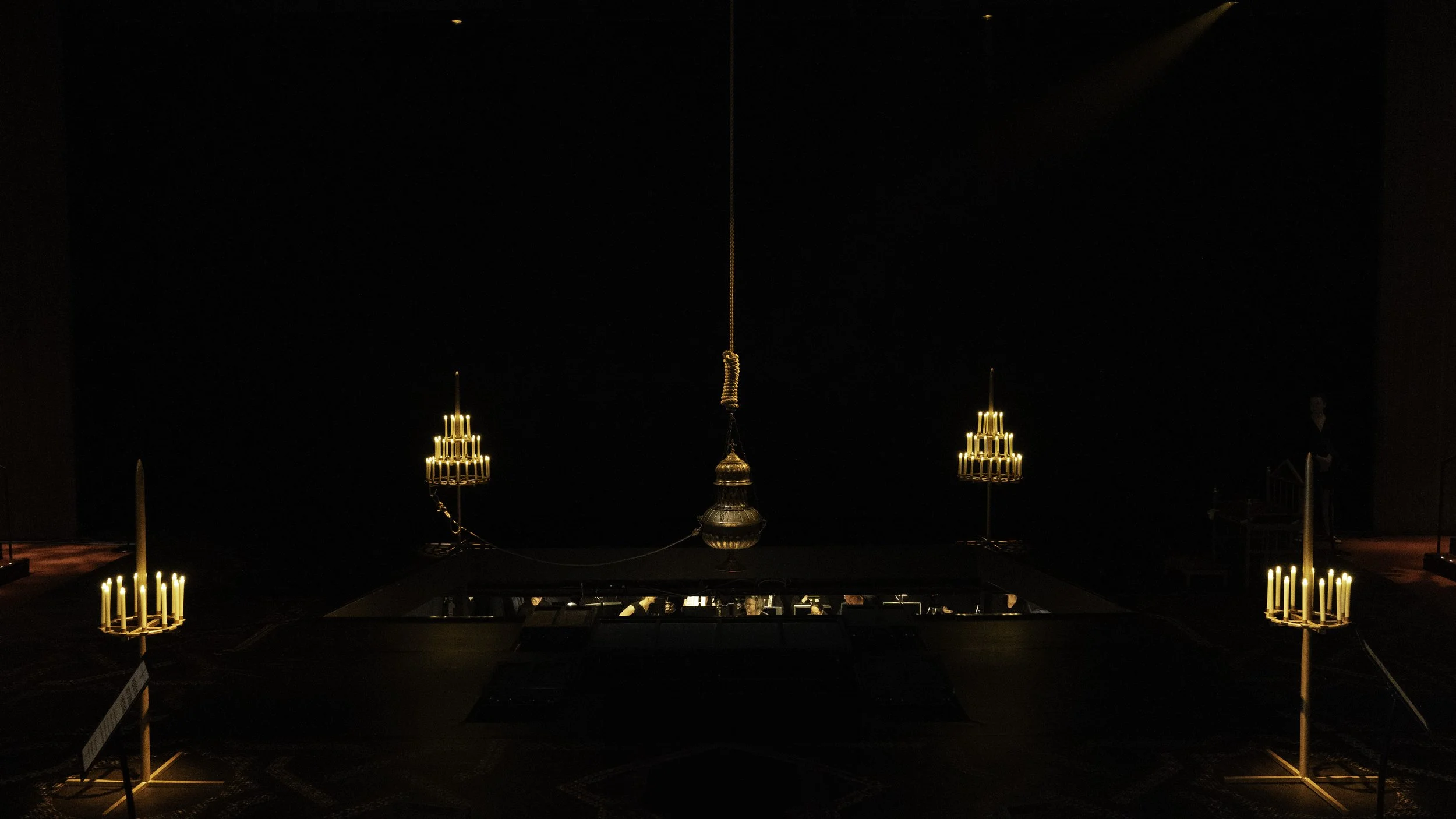
“An immense censer hung motionless over the Iowa stage, illuminated by four standing candelabras and suspended above the pit orchestra. The scale of it was unsettling. For a long moment, these were the only visible objects but then, one by one, members of the chorus filed into the Pote Theatre, their stately procession lending the scene a ritual air. The Archbishop released the censer, and it swung ominously over the orchestra like a pendulum. The chorus launched the opening invocation, ‘Holy, holy!’ as King Roger and his wife, Roxana, entered. An altar rose silently and swiftly from beneath the stage, drawing the audience into a world of anxious mystery where certainty begins to lose its grip.”
— Zach Carstensen, Seen and Heard International



“As Roger sang his hymn to the sun, behind him an old theatrical technology worked its absolute, perfect magic. Very slowly, from the water-covered stage, a backdrop ascended, on it the brilliantly lit half circle of a rising sun. I will never forget it.”
— Garth Greenwell, To A Green Thought


REVIEWS:
“…One of the most thrilling evenings I’ve ever spent at the opera…The set was sparse at the start of the show, with four candelabra and, its most striking feature, a large censer hanging over the orchestra pit…The conductor (David Neely, the company’s musical director) took the podium in silence, without a bow; lavishly costumed church officiants processed on stage in silence; the downbeat arrived when the archbishop (Ben Strong, terrific in the small role), in an exciting gesture, set the censer swinging over the orchestra. Szymanowski’s score calls for huge forces: choir, children’s choir, soloists; soon the stage was full. Roger and Roxana, in ceremonial robes, entered from the house, processing as the officiants had; a lush altar suddenly rose from beneath the stage, in front of the orchestra pit, flanked by four angel-topped pillars. More of the back of the stage became visible (was a curtain lifted? was it just a matter of lights?), revealing an elaborate Byzantine church, true to Szymanowski’s intentions, with a huge doorway, above it a mosaic-like image of Christ. Atop pillars, members of the chorus stood in what seemed almost like vitrines, like life-sized statues of saints. It was a stunning effect, to move from the stark opening to the opulent full set. The scenic design, by Jimmy Stubbs, was superb throughout the opera, triumphant: a brilliant, maximalist use of a very limited space…I still don’t know what Szymanowski is after at the end of the opera, but I believed something, in part because Elliott made such a striking figure, with his absolute commitment and his Greek statue physique…As Roger sang his hymn to the sun, behind him an old theatrical technology worked its absolute, perfect magic. Very slowly, from the water-covered stage, a backdrop ascended, on it the brilliantly lit half circle of a rising sun. I will never forget it.” — Garth Greenwell
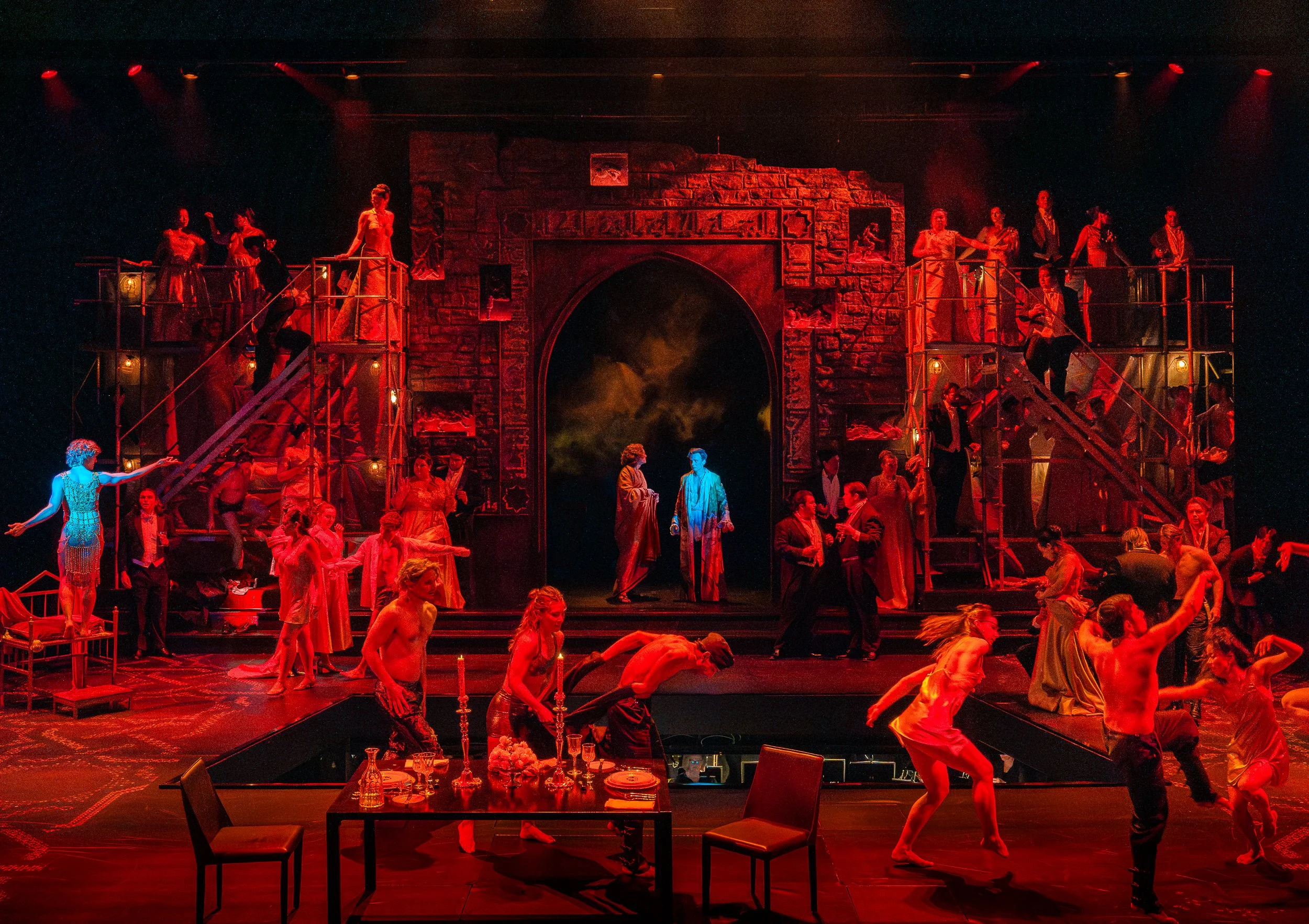
“Des Moines Metro Opera’s unsurpassingly ravishing production of Karol Szymanowski’s King Roger has joined the ranks of the finest performances I have ever experienced…Scenic designer Jimmy Stubbs has devised no end of mind-blowing visual effects. The ornate church interior of Act I included choristers as “statues” of saints perched on pedestals midway atop pillars, an elaborate throne, candelabras, and an ornate altar with columns that rises majestically from the trap. Act II devolves into a period cocktail party with scaffolding and iron gates, while Act III strips all trappings away, with only a ruined, upturned throne left down center, and a black platform up center, underscoring Roger’s moral condition. And then. . .it magically rains a purifying rain after which a giant white sun rises, framing Roger as he ponders all that has been revealed to him. Jaw-dropping and masterful, indeed.” — James Sohre, Opera Today
“The true star of the opera was the production itself…The scenery and lighting designs by Jimmy Stubbs and Connie Yun, respectively, were breathtaking, particularly in the opulent first act. The gilding gradually stripped away as the opera progressed until Roger was left in a barren landscape with an overturned throne. Natural elements were crucial to the opera’s visual language. Smoke poured from a giant thurible. Water rained down as dancers crossed the stage. It all made for a powerful assault on the senses that drew the audience in.” — Meghan Klinkenborg, Little Village Magazine
“The scenic design by Jimmy Stubbs plays with the dualities of a bare stage to an opulent set in Act 1 alone. As you walk into the theatre, you see a few candelabras and a bare-bones metal throne. If you take the time to look more closely before the show, you get a sense of where the set is going from the ornate detail in the flooring. There is a moment in Act 1 where you see the full set in all its grandeur. The duality continues in his storytelling as we see opulence stripped away in the following acts.” — David Felton, BroadwayWorld